Project Goal
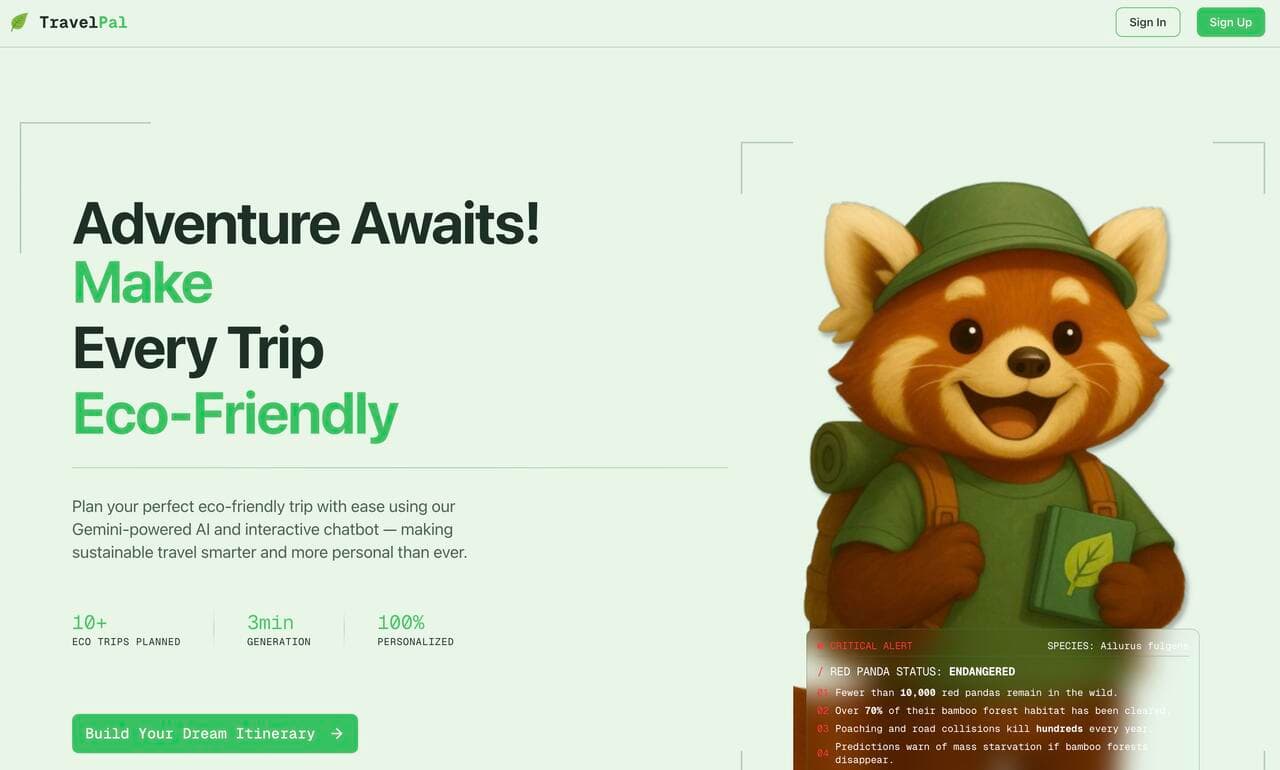
The idea was to build a travel assistant that could do more than produce a generic itinerary. We wanted TravelPal to understand user preferences, generate a structured schedule, and surface the environmental cost of the plan in a way that was easy to act on. Instead of treating sustainability as a separate report, we built it directly into the trip-planning flow through Eco Mode, carbon summaries, and alternative recommendations.
Full-Stack Architecture
My team and I built the application with Next.js for the frontend and Convex for the backend. Convex handled the real-time data layer for saved trips, profile data, and itinerary state, which helped us move quickly during the hackathon without spending too much time on backend boilerplate. The frontend included a responsive dashboard where authenticated users could manage multiple trips and revisit previously generated plans.
Authentication was implemented with Clerk, giving the app secure sign-in and user-specific trip storage. That made the product feel closer to a real shipped application instead of a single-use demo. Each user could create, save, and manage their own travel plans, which was important for making the project feel complete under a short build window.
AI Itinerary Generation
Google Gemini powered the core itinerary generation. The app used user inputs such as destination, trip duration, and travel preferences to generate day-by-day plans focused on low-impact activities and eco-conscious choices. We structured the AI output so it could be displayed as a usable itinerary rather than a loose block of text, which made the generated plans easier to scan and refine.
To streamline the experience, hero images were generated automatically instead of requiring manual image assets for every destination. This helped the app feel more personalized while keeping the workflow lightweight for users. It also gave each trip a stronger visual identity inside the dashboard.
Eco Mode and Carbon Awareness
A major part of TravelPal was Eco Mode, which calculates travel distances and estimates CO2 emissions for each leg of a trip. The goal was not just to show a number, but to help users understand which parts of the itinerary created the most impact. From there, the app could suggest greener alternatives, such as lower-impact activities, more efficient routes, or choices that reduce unnecessary travel between locations.
This feature made the project more technically interesting because it connected AI generation with measurable trip data. The itinerary was not only creative output from a model; it became something the app could analyze, summarize, and improve based on sustainability criteria.
Voice and Chat Interaction
We also implemented a live voice and chat interface using Vapi, allowing users to interact with the AI in real time. This gave TravelPal a more natural planning flow: instead of changing form fields repeatedly, users could ask follow-up questions, refine parts of the trip, and explore alternatives through conversation.
What I Learned
As our first hackathon project, TravelPal taught us how to design, build, and deploy a complete end-to-end application under time constraints. We had to divide responsibilities quickly, make practical architecture decisions, and focus on the features that would make the product feel real: authentication, saved data, AI generation, voice interaction, and a polished user interface.
The project gave me hands-on experience collaborating as a team, integrating multiple AI tools into a single product, and turning an idea into a functional full-stack application. It also reinforced the importance of building around a clear user problem: helping people plan trips that are not only personalized, but also more environmentally aware.